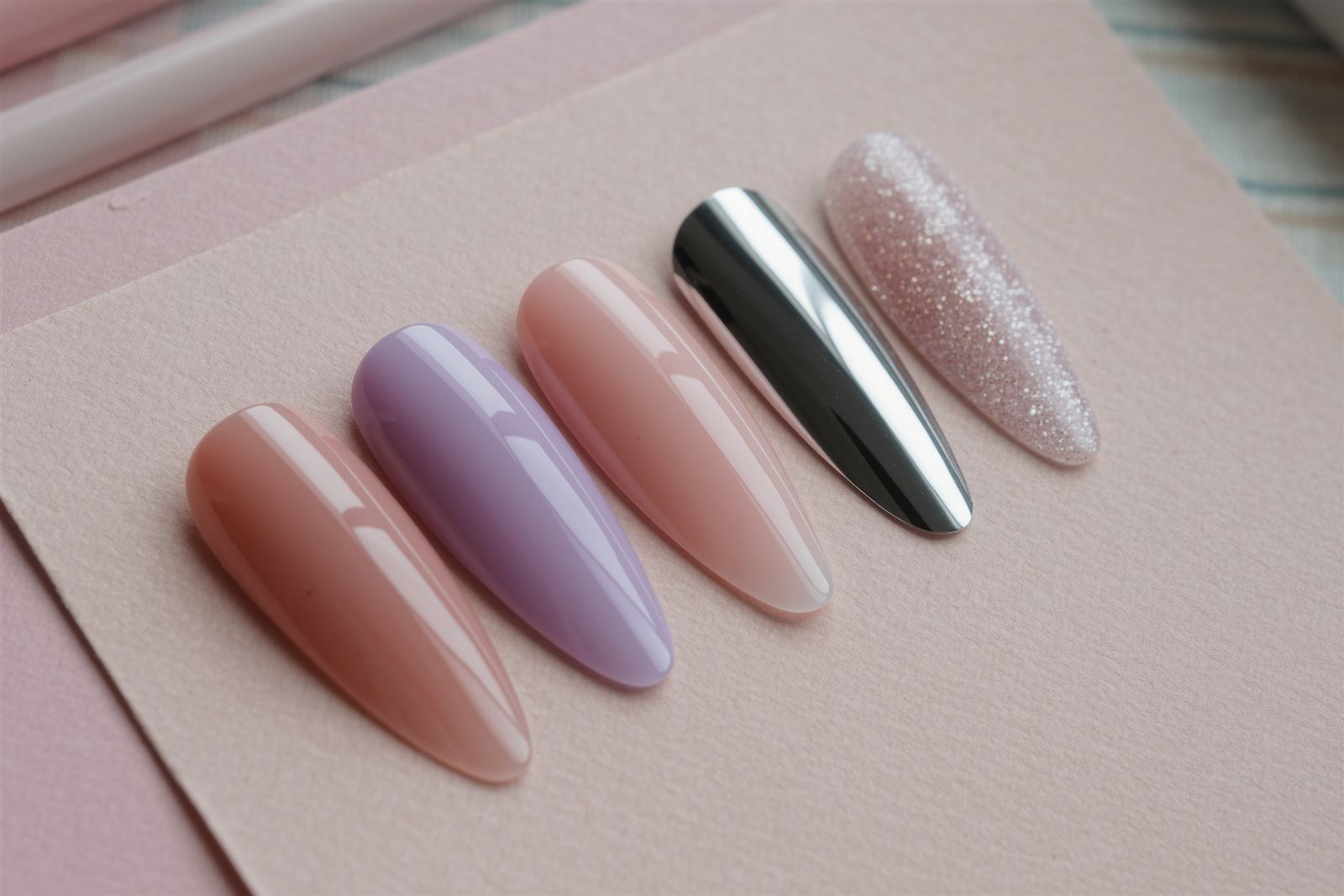
Four ways to wear color on your nails
A menu at a Minneapolis nail salon usually offers some mix of regular polish, gel polish, dip powder and acrylic or gel extensions. They look similar once the top coat goes on, but they are made of different things, they come off in different ways and they ask different things of your natural nails. Knowing the difference before you sit down makes it easier to pick a service that fits your week, your budget and your nails.
| Type | What it is | How it comes off | Good to know |
|---|---|---|---|
| Regular polish | Lacquer that dries in the air | Polish remover on a cotton pad | Quickest to change, chips sooner |
| Gel polish | Color that cures under a UV or LED lamp | Acetone soak or professional removal | Cured under a lamp, so hands see UV |
| Dip powder | Nails coated with adhesive and dipped in colored powder | Acetone soak | Ask how the salon keeps powder clean between clients |
| Acrylic or hard gel | A sculpted layer that adds length or strength | Filing down and soaking, done by a technician | Needs fills as the nail grows out |
Regular polish
Regular polish is the simplest option. It is brushed on in thin coats, dries without a lamp and lifts off with remover. The Food and Drug Administration regulates nail polish and similar products as cosmetics, and it advises reading the label, following the directions and using good ventilation. If you like to change color often, or you want to give your nails a break, regular polish is the gentlest of the four. A clear polish that is free of formaldehyde is a sensible choice for nails that tend to split.
Gel polish
Gel polish is the long-wear version of a polish manicure. Each coat is cured under a lamp, which is why a gel manicure comes out of the salon completely dry. The Cleveland Clinic points out that curing exposes your hands to UVA light and that LED lamps still give off UV radiation. Its dermatologists describe the cancer risk from the lamps as low but not zero, and they suggest limiting how much UV your hands get. Two practical options are a broad mineral sunscreen with an SPF of 30 or higher put on before the lamp, or fingerless UV-protective gloves that leave the nail exposed.
The bigger day-to-day issue is removal. Peeling gel off strips layers from the nail plate, and the same source calls that one of the worst things you can do to your nails. Soaking is the safer route: roughen the shine, hold acetone-soaked cotton on the nail and wrap it in foil for 10 to 15 minutes, then ease the softened gel off with a plastic or wooden stick. A technician can also do this for you. Gel also contains acrylates and methacrylates, which can cause contact dermatitis in some people.
Dip powder
Dip manicures coat the nail in a base adhesive and then in colored powder, repeated for a few layers and sealed. They need no lamp, and many people like the sturdy, smooth finish. Removal is by acetone soak, much like gel. Because the powder is shared during the service, it is reasonable to ask how the salon handles it: whether the powder is poured over the nail or the nail goes into a shared jar, and how the brush is kept clean. A good technician will answer without fuss.
Acrylic and hard gel extensions
Acrylic and hard gel add a sculpted layer to the natural nail, either to lengthen it or to strengthen it. Many Minneapolis menus also list builder gel, which is a thicker gel applied over the natural nail for strength. The FDA notes that traces of the liquid ingredients in artificial nail products, the methacrylates, can cause allergic reactions, and it advises keeping them off your skin. That is one reason to choose a salon where the technician works neatly and keeps product away from the cuticle skin. Extensions need a fill every few weeks as the nail grows, and removal is best left to a technician.
How to choose
- If you want zero commitment, choose regular polish and a clear top coat.
- If you want a manicure that lasts through a busy month, choose gel, and plan a break between sets so the nails can recover.
- If your nails break often and you want strength, ask about builder gel or a dip, and ask how it will be removed.
- If you are going to a wedding or an event and want length, acrylic or gel extensions are the standard answer.
Whichever you pick, leave your cuticles alone. They are a natural barrier against infection, and a moisturizer or cuticle oil every day does more for the look of the nail than clipping them. Read about healthy nails basics for more, and see choosing a nail salon for the questions that apply to every service on the menu.
Questions people ask
Is gel polish bad for your nails?
Gel itself is not the main problem. Peeling it off, skipping breaks between sets and cutting the cuticles do the damage. The Cleveland Clinic suggests limiting gel to a few times a year and removing it by soaking in acetone instead of peeling.
How do I take off gel polish at home?
Rough up the shine with a file, rest acetone-soaked cotton on the nail without covering the skin around it, wrap each finger in foil and wait 10 to 15 minutes. Use a plastic or wooden stick to ease off the softened gel.
Do LED nail lamps give off UV?
Yes. The Cleveland Clinic notes that LED lamps still emit UV radiation. Sunscreen before curing or fingerless UV gloves reduce what your hands receive.
Can nail products cause allergic reactions?
They can. The FDA says traces of the liquids in artificial nail products can cause allergic reactions, and gel contains acrylates that can cause contact dermatitis. If you react, talk to your doctor and consider reporting it to the FDA.
What is the gentlest option for weak nails?
Regular polish with a clear base coat, applied in thin coats, with plenty of moisturizer and cuticle oil. Take breaks from any enhancement while the nail recovers.